Visit Our YouTube Channel

Visit Our YouTube Channel: Commack FEC

Monday, December 16, 2013

Museum of Modern Art

Hey everyone! Hope everyone is getting excited for Christmas break! However, there are still just a few more days of studying and school work we have left to get through. Anyways... enjoy this post!

Just recently, Commack High School's IB Design Technology classes (standard level and higher level) took an exciting trip to the Museum of Modern Art(MOMA) in NYC. The purpose of the trip was to take what we learned in class and apply it to real life. 

Our trip started off by piling over 30 excited kids onto the Long Island Railroad. After about an hour long train ride and 30 minutes of walking, we finally arrived.
Our first step was the to visit the Applied Design exhibits to learn about materials and design as well as how form and function can be combined to produce things we use everyday. There are people who think that design is just about making things, places, and people pretty, however, MOMA's exhibits will change that thought. We had the opportunity to see 3D printed objects, hand made objects, animal made objects, and even video games! Below are just some of the many exhibits we got to see:

The Endless Flow Rocking Chair
Dirk Vander Kooij created a chair different than most. What made it so unique was that it was 3D printed. He used an old, industrial robot and reprogrammed it in such a way that it could "print" furniture. The robot extruded recycled refrigerator interiors into chairs and any other kind of furniture. The term "endless" refers to the chair's endless thread of synthetic material as well as it's endless design possibilities. 

Mine Kafon
When the Afghan countryside was covered with over ten million land mines, Massoud Hassani invented a 70 kg, 190 cm diameter, machine that meanders across the terrain by chance, propelled by the winds, detonating bombs as it tumbles over them, mapping it's whereabouts by GPS. Though it’s simplicity and symmetry made it so aesthetically appealing, its quality of design was even better. With each detonation, Mine Kafon only lost a few legs, allowing it to destroy three or four mines in one journey. It was simply built using $40 worth of recycled bamboo and plastic along with a skeleton made of spiky plungers.


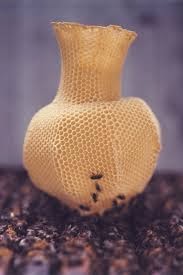
The Honeycomb Vase "Made by Bees" 

Tomas Gabzdil Libertiny designed and made a vase by casting solid beeswax into a shape. Then, he decided to see what would happen if he allowed bees to contribute to the process. He created a vase-shaped space inside a beehive and installed a camera to film the process. The bees worked like a machine. Slowly, layer by layer, they added tiny bits of beeswax. He and the bees have now produced a dozen Honeycomb Vases. This shows that even animals can use applied design to create magnificent pieces of art. 
Pacman
While eating pizza for lunch one day, Toru Iwatani had a vision of a character- a giant yellow circle with a wedge removed for a mouth. The player controls Pac-Man with a joystick, directing him to eat all of the dots in the maze while eluding the ghosts, who can end his life. If he succeeds, he moves up a level. Eating special power pellets gives Pac-Man the ability to kill the ghosts, and by eating transformed ghosts, assorted fruits, and other objects the player can gain bonus points. Eating to gain power, Iwatani has said, was a concept he borrowed from Popeye. He used ideas from other influences as well as applied his own ideas to design a video game that is still played to this day. 

After completing the Applied Design exhibit, we explored the remainder of the museum and saw other interesting pieces of art and designs made by artists who are popular to this day. Here are some more pictures of students viewing the artwork from the rest of the museum:


'


After the museum, we stopped at Rockefeller Center to see the Christmas tree and take pictures. Here are some cute group shots:


Later, we went to Dallas BBQ and had a feast. It was like Thanksgiving all over again! We had a large assortment of appetizers, from fried onions, cole slaw, vegetables, to even chicken wings. Then, for our meal, we got a giant, personal rotisserie chicken, french fries, and corn bread. It was delicious! To top it off, we got an ice cream sandwich for dessert.


After a long day filled with walking and eating, we were all ready to go to the train station for the train ride home. It was an amazing day filled with learning and memories. Not only did we learn a lot about the importance of Applied Design, but we all had some good laughs and bonded over the trip.


Hope you enjoyed the post!


~Ashley 


Wednesday, December 11, 2013

Cradle Trip

Hey Everyone. During the month of November we went on a field trip to the Cradle of Aviation. At the Cradle of Aviation there was a multitude of science, technology, engineering and math(STEM) employers highlighting the STEM careers available on Long Island. Some of these companies included: Northrop Grumman, Seal Dyanmics, Lockheed Martin and Spectronics. Many students during this trip were able to realize if they truly wanted to go into a STEM oriented career in the future by listening to presentations by these employers. When we got to the Cradle of Aviation during the opening notes we listened to a astronaut’s experiences in space. She told us what it was like to live in space and presented various pictures of the Earth from space. Overall it was a great trip where many students got to see the real life careers that correlated to the topics learned in: design technology, electronics, robotics and computer design and drawing.


Wednesday, October 23, 2013

Makey Makey

Hey everyone! We just got a shipment in from Adafruit, a New York based Electronics Company, with tons of really cool items. This includes a Raspberry Pi board with the camera module, an LED 8x8 matrix,  a Arduino shield that logs temperature, and a Makey Makey. We started experimenting last week with a few of these items and we had a lot of fun using the Makey Makey.
       
The Makey Makey is a device that allows for any conductive material to become a touch sensor. For example we could make a banana into a touch sensor so that when we touched the banana it makes a sound. So far we have made pizza dishes, pencil drawings, skin, desk trays and keys into touch sensors. Based on when you touch any of these items, a sound will play. This is because the Makey Makey is seeing that you touched something and then registering this into the computer as a keystroke. We ran an application that showed that the keystrokes entered would make various sounds.
            
The Makey Makey is actually a pretty simple device to use and setup. First, hook it up to a computer and download all the necessary drivers, which allows the Makey Makey to act as a keyboard. Then, connect an alligator clip to the various arrow or keyboard keys. For example, there is an up arrow key which you would hook an alligator clip up to and then you would hook the other end up to a conductive material (ex. a pizza dish). Afterwards,  hook another alligator clip up to a ground pin on the Makey Makey and hold that in your hand. When you go to touch the conductive material, it will register this as a key press.
            
The Makey Makey is an ATMega32u4 chip running firmware from the Arduino Lenardo board. The board can be reprogrammed to work with any mouse or arrow keys if desired. Electrically, the principal behind how the Makey Makey detects touch is by grounding an input. Basically, when you touch what ever is connected to the Makey Makey, and if you are connected to the ground, you are effectively grounding the circuit to a logic 0. In order to keep the circuit to a logic 1, before the object is touched, a 22 mega ohm pull-up resistor is used. This is basically a resistor connected to a positive voltage. Overall, the Makey Makey is just seeing when it detects a logic 0. In order to remove any electrical noise in the circuit a running average is used to help differentiate signal from noise. 

It's been a lot of fun using the Makey Makey over the past week and we look forward to making more musical projects. What do you think about possibly combining the Kinect and the Makey Makey?!


Below is a video of what we've made our Makey Makey do:


~Anthony

Technology Honor Society Begins

     Congratulations to all new Technology Honor Society members! Students must go through a very rigorous application process in order to get into the Commack chapter of the National Technical Honor Society. Students are required to have taken at least one technology class and to have received an average of above a 90 in it. In addition, students must also have above an 85 overall unweighted GPA in order to apply. Since the majority of our previous members graduated, we were looking for the most technologically influenced students, or the ones having the greatest interest in technology.
     This past Monday, we got the year started by having our first THS member meeting. At this meeting we went over student requirements for the year as well as different events/activities that are taking place. The other officers and I have major plans for success this year in the honor society. We are very excited to work with these new students and to make technology an influence throughout the school. 
     Overall, congratulations to our new members! The Induction Ceremony will take place in March. And thank you to our advisor and officers for making the start of the year a success!


~Ashley 

Monday, October 21, 2013

Just the Beginning

     Hey there, readers! Hope the school year is starting to calm down for everyone. Though it has been chaotic, Commack's Technology Department has been back in the swing of things! Even though it is still just the beginning, our Future Engineers Club has made a lot of progress already. With approximately 50 members, it can be hard to control meetings. Fortunately, each and every one of the students is dedicated to learn. At every meeting, kids separate into small groups to learn things such as Arduino, 3D printing, Auto-cad, Inventor, and more! Not only is this a great way for to students to expand their knowledge of technology, but a great way to meet new people. Below are some pictures of the students working with each other:


Great job to our officers who have made this year this  successful thus far!

Officers:
President- Anthony Bisulco
Vice President- Danny Lukach
Treasurer- Jared Becker
Secretary- Ashley Cooper

      Currently in the club, we are working on our project for the Halloween Happening, which is this Friday. More posts will be coming soon to talk about the different projects! 

~Ashley 
:

Monday, September 23, 2013

MIT InvenTeams

    Hello everyone! School just started and Commack's technology department is still getting back into the swing of things. Soon will come more posts about our projects, designs, and more! In the mean time, I just wanted to talk about how some other engineers and I spent our summer.
    Every four years, Commack participates in what is known as the Lemelson MIT InvenTeams. This competition requires a small, dedicated group of students. The process runs over the course of approximately a year until you finally reach the end, which is physically going to MIT. The whole idea of the competition is to create an invention which will make a change in the world. Whether it is something that is a solution to a major problem, or your own general creation, the process is totally worth it.
    This year, Commack was lucky enough to have eight truly dedicated students as well as an incredible advisor to spend countless hours with while working on this project. The other students and I put in time once a week, every week, during the summer to meet with each other and work on the most important part of this process; the proposal. The proposal gives all of the details behind the design, the problem, our solution, and most importantly, our budget. In the proposal, we had to state what materials we would need to use, as well as its expense. Our proposal is used as our submission meaning that if we get in, MIT will send us all the money we need for the project. After that we get to build the whole thing and then head over to MIT in June for the actual competition. 
     This whole competition involves the use of the Design Process. After brainstorming a lot of ideas and issues in our world, we came up with a portable, in car solution to wrong-way driving. Approximately 350 people get in wrong-way crashes each year. However, our device can fix that. Our device will be able to detect signs and will immediately alert you when you are driving the wrong direction. This device can be used in all car models. It will be small and compact, but it will do it's purpose. It can be very beneficial and decrease the amount of wrong-way crashes each year.
            Though we cannot predict what will happen in our future, all we can say is that we worked as hard as we possibly could on this project already. We have gotten so far and we are so proud of that accomplishment alone. Working together as a team isn’t always easy. Agreements, disagreements, different ideas, etc. are all factors that make group work more complicated. However, our team worked so well together and made so much progress. I am so thankful to have the opportunity to work with these people. I am so proud of the success we’ve had already. 

Thank you to Mr. Castrogivanni, our advisor, as well as congratulations to our members on how far they have come:
Jared Becker
Anthony Bisulco
Binoy Daniel
Daniel Lukach
Ashley Cooper
William Claus Jr.
Claire Drotman
Alexa Girimonte


     Below is a picture of the hardworking students as well as our advisor (minus Binoy):


     I hope you all enjoyed this post! Hopefully this inspired you to work in a group and maybe come up with your own life-changing invention! 

~Ashley 


Wednesday, April 17, 2013

New York Institute of Technology Engineering Showcase

     On Tuesday, April 9th,  for the second year in a row, Commack was lucky enough to attend the New York Institute of Technology(NYIT) Engineering Showcase. This is one of the biggest events throughout the whole year for technology members in Commack. This is a time where students from various schools get to display their ongoing projects to a panel of judges. The judging panel consists of NYIT staff, Cradle of Aviation members, Verizon workers, Motorola staff, and even students of NYIT or other colleges. The top three winners are chose by the judges each receiving a monetary prize.
     In order to prepare for this event, about 10 of us worked together and stayed after until around 9:00 at night or later almost everyday. To help pass the time, we had some delicious meals as well as some fun times. Below are pictures of us preparing for the showcase:


     This year, Commack had three groups; The Eye Hand, A Facial Identification Quadcopter, as well as a Body Motion Controlled Quadcopter.   The first group consisted of Daniel Lukach, Jon Raitses, and Daniella Azoulay. The Eye Hand was an innovation in Blind-Sensory technology. This device allows people to detect things at different distances based on the rate of vibration of the prototype. For example, if a student were to walk into a wall while holding the device, the closer the student gets to the wall, the stronger the vibration will be. In the future, making this contraption into a small glove can easily assist the blind and make finding objects more efficient.
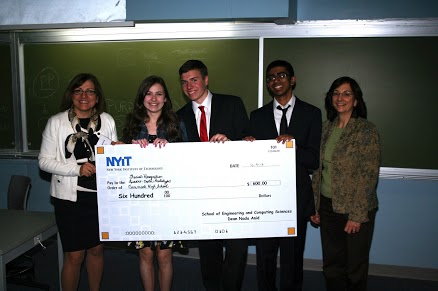
     The second Commack group was the Facial Identification Quadcopter by Anthony Bisulco, Ashley Cooper, and Binoy Daniels. The goals of this project were to build a stably flying quadcopter that can identify faces. In addition, we thought this project would improve the amounts of surveillance throughout the world.  With the use of a small camera, the Quadcopter is successfully able to detect/identify people's faces.  In the future, low scale Quadcopters can be used on planned investigations as well as solving a crime.
     The third Commack group was entitled the Body Motion Controlled Quadcopter. Stephen Mendez as well as Kayla Houshmand believed this project demonstrated a unique way of controlling a wifi remote Quadcopter with the help of a Mircosoft Kinect. By standing in the view of the kinect, whatever direction your body moves, the quadcopter moves with it. For instance, if you move your body left, the quadcopter will shift left as well.
     Overall, Commack did very well. We placed in two of the top three monetary winners. The Eye Hand recieved first place which earned a $1,000 check. However, the Facial Identification Quadcopter recieved third place, as well as $600. The Body Motion Controlled Quadcopter received the Creativity Award.  Commack came home with the most Creative award as well as $1,600 all in one day. Below are our pictures from this amazing experience as well as a video of the Body Motion Controlled Quadcopter!


Check out these links to two awesome videos of Stephen and Kayla's Body Motion Controlled Quadcopter:


~Ashley Cooper